
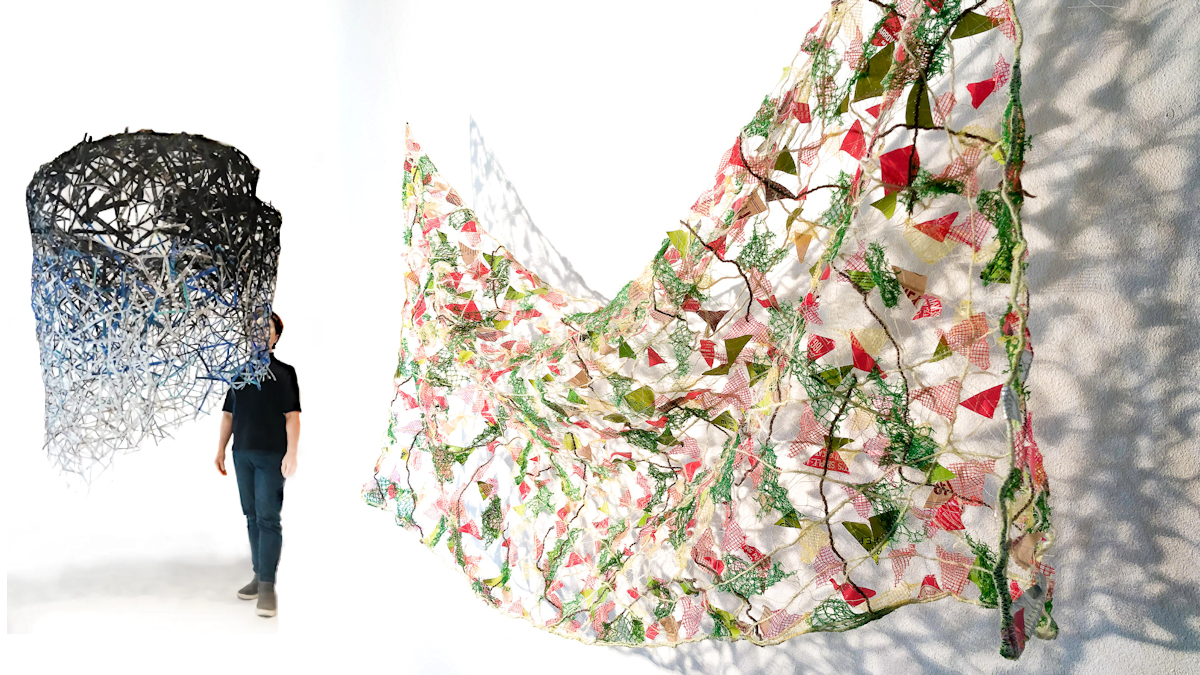
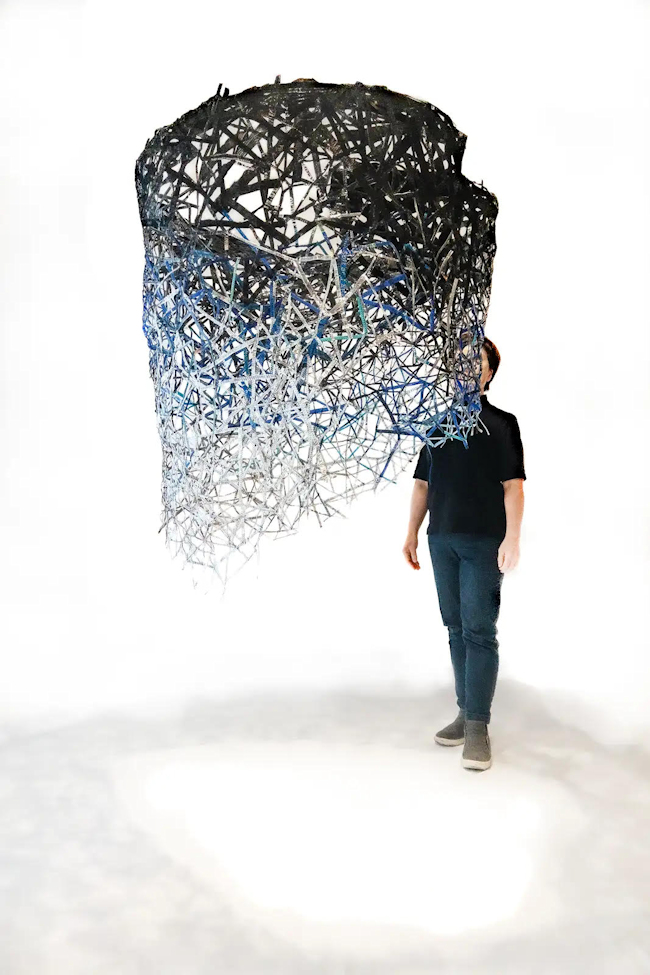
Bella Kim’s art is both delicate and large in scale. As you encounter her pieces, the myriad of brightly colored, intricately stitched pieces in swirling matrices envelope you in a light embrace, seemingly inviting you to dance with them; as you look closer they are made of sterner stuff, recycled woven plastic packaging with writings and messages therein tell of more serious environmental concerns, and bring us necessarily back down to earth again.
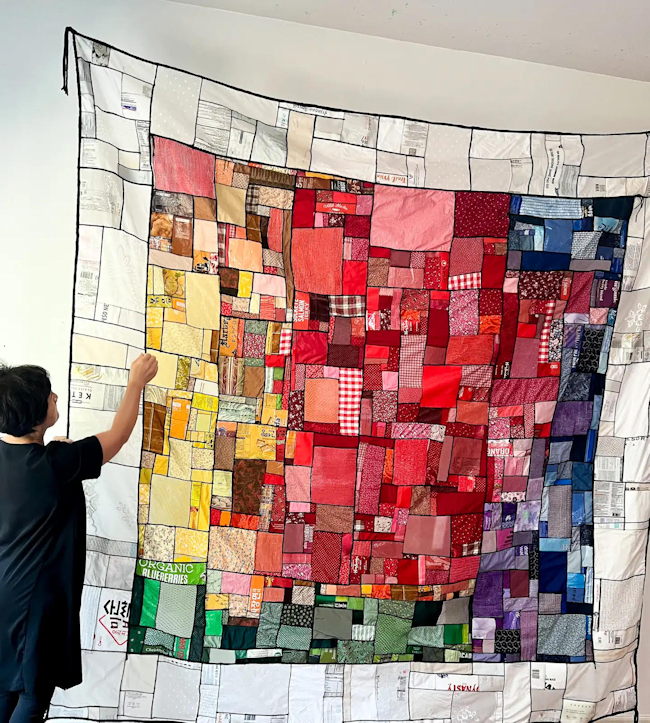
Kim combines the traditional discipline of jogakbo while employing the no-waste policy of her parents’ generation who were recovering from the Korean war. Resources were scarce, and they would need to reuse everything. Jogakbo (literally translated: small pieces, wrapping) is a discipline Kim inherited from her Korean culture, and which she learned from her mother as a young child. Traditionally, jogakbo was hand-stitched and made with all-natural fabrics such as silk or linen. She says only royalty and rich people could afford swaths of single fabric, so jogakbo became the discipline of the working-class people. Kim points out that jogakbo is fundamentally different from US quilting. With US quilting, there is a plan before it is stitched, with jogakbo the practice is more often organic, figuring out what works while you go.
In her choice of materials, Kim says she initially was attracted to the vivid and beautiful colors of salvaged packaging, also the sheer abundance of these discarded materials, noting that we’re super overwhelmed with it.
On a practical level she finds this liberating as not only does she not have to buy expensive art products, allowing her to work on a large scale, but she doesn’t have to worry about adding to the heaps of discarded stuff in our throwaway society. Her materials are already destined for trash, so by making something beautiful to be treasured she is saving it from landfill. In this way she has far fewer limits to the possibilities in her art practice, freeing her to work as large as her imagination takes her. Her materials comment on the wasteful abundances of modern commercialism while also acknowledging and bridging the traditional and modern sensibilities embodied in her works.
Kim is motivated in her art by a few life incidents. When her parents passed away, she was left with the task of assigning their voluminous belongings to family members. She said there was so much of it she worried if the inheritance of these objects was more of a burden or a joy for her children and future generations. Her good friend Jade Trevere is another influence. She is a disciplined and passionate conservationist, who inspired Kim to be responsible about the materials she uses, to elevate existing materials rather than using new ones and adding to the earth’s burden. Also, incidentally, during the pandemic she was the President of the Korean American Artists of Washington and like many, she began producing art with the extra time at home. This time allowed her to explore and expand the realms of possibility in her work, while also looking for appropriate places to display her pieces. Kim is blazing a trail for herself, she has shown most recently at SPSCC, Bainbridge Island Museum, Postmark Center in Auburn, Pierce College in Steilacoom, and The Gallery at Tacoma Community College among many others. In 2026 she will be showing at Gallery B612 in Seattle during January, Tateuchi East Asia library, UW, Seattle during April, and Gallery One, Ellensburg during Oct. Kim has recently been selected to be on the City of Seattle’s 2025 Midterm Public Art Roster, as well as the Washington State Public Art Roster (2025-2029).
Kim’s earlier works are more abstracted and organic in appearance, but the work she showed last October in the recent group show Women’s Art Exhibition, at TCC (with local Olympia sculptor Irene Osborn, painter Patsy Suhr O’Connell, and bojagi artist Leoni Castellino curated by Dr. Jennifer Olson) she introduced more themes exploring women’s experiences of care and labor, and roles passed down intergenerationally.
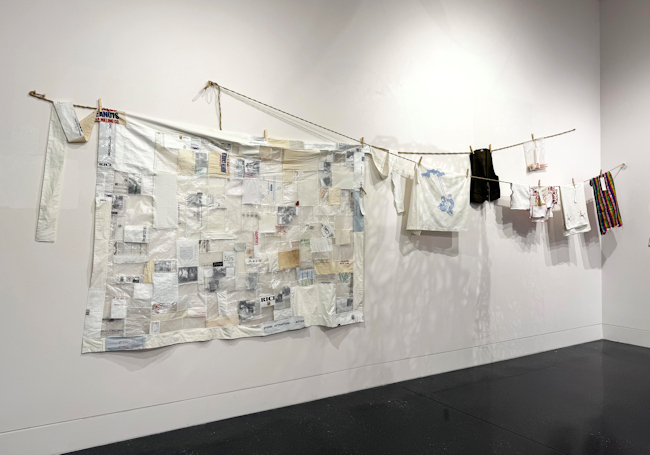
With Memories on the Line, one of the pieces in this show, Kim utilized a washing line for display and context purposes pinned to which are a large jogakbo apron made with product packaging. Multiple pockets hold memorabilia and photos from her family. Other household items adorn the line, as well as a much-loved doll and clothing passed down from her mother, writing on the packaging is pertinent to the theme of the show.
Kim will be leading a collaborative art project at Arbutus Folk School this spring on May 21st and 28th. Offered at no cost thanks to a grant from the Community Foundation of South Puget Sound, the two workshops will guide participants in cutting, shaping, sewing, assembling, and eventually installing a large-scale work that builds on her piece titled Jack’s Dream. This original work was previously shown at TCC and was inspired by the fairy tale Jack and the Beanstalk. Huge and lyrical, the piece is constructed of leaf-shaped jogakbo pieces winding up to the ceiling like a beanstalk gone out of control. When you stand underneath it you feel that, like Jack, you are lost in the magnificence.
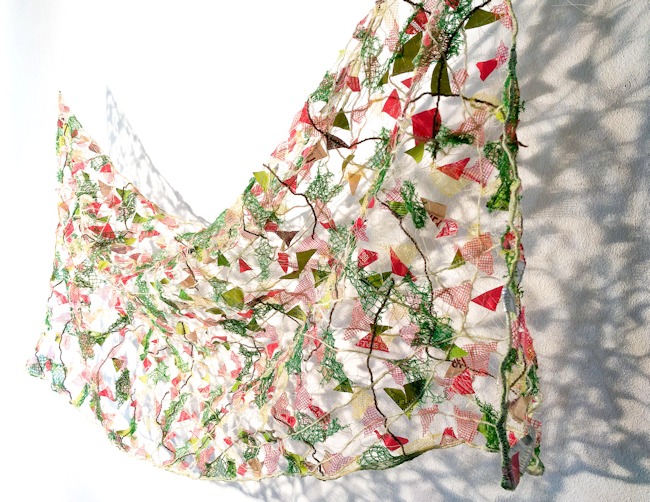
Kim was inspired by watching bean sprouts grow for the first time; she said it felt magical like the sense of wonder Jack experienced as described in the fairy tale. She explains that Jack gained freedom through finding gold, but notably her interpretation differs from the original story. For Kim, the beanstalk represents breaking free from stereotypes and fixed ideas to open pathways to new possibilities rather than seeking material wealth.
Kim says the grant and Arbutus will enable her to make Jack’s Dream either bigger or make an entirely new one. The resulting artwork will be on permanent display at Arbutus. Check out Arbutus closer to the date and join in with the adventure.
WHAT:
Collaborative Art Project with Artist Bella Kim
WHEN:
May 21 & 28, 2026.
WHERE:
Arbutus Folk School, 705 4th Ave E, Ste 101, Olympia
HOW MUCH:
Check with Arbutus
LEARN MORE:
https://www.hisawyer.com/arbutus-folk-school/schedules/activity-set/1765945
(360) 350-0187
https://www.bellakim.com