
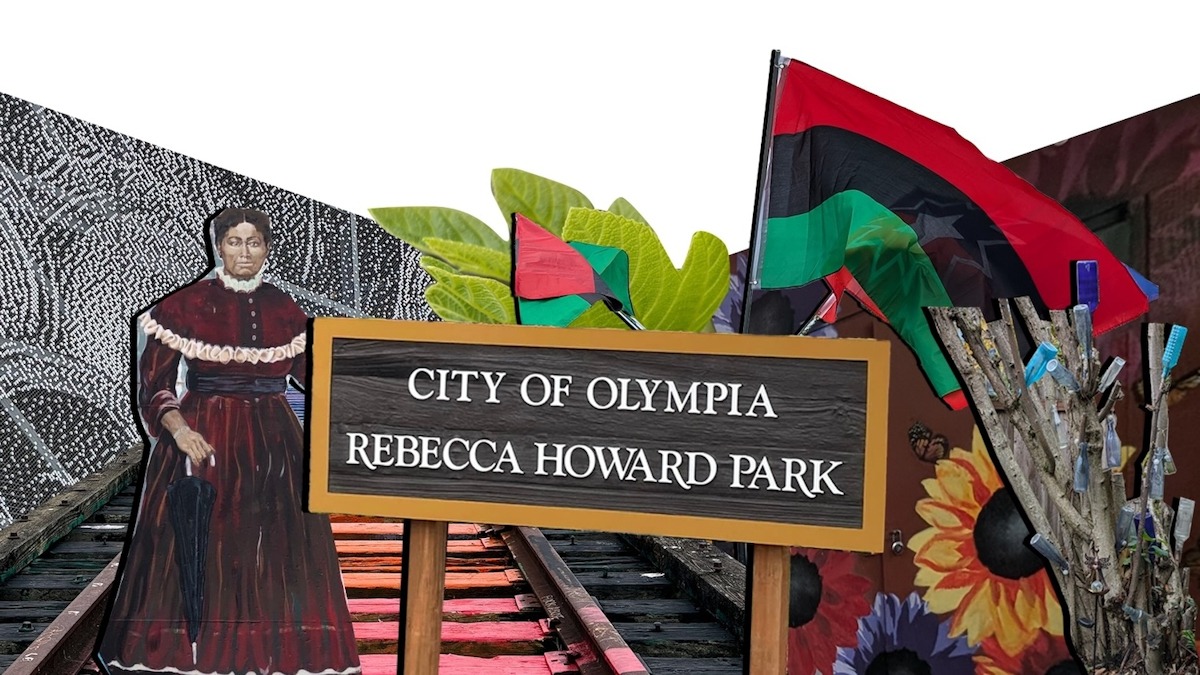
Plans for Olympia’s Rebecca Howard Park, named for a Black pioneer and pillar of the community in the city’s early days, would transform the downtown green space into a cultural hub including a covered stage, layers of public art, multiple gathering spaces and even a café.
The café, envisioned as a public-private partnership, would be the first of its kind in an Olympia park. Plans call for another first: a festival street — which functions like a plaza and is easily closed off for festivals — along 9th Ave. SE between Adams and Franklin. Across that street, the Olympia Timberland Library would also get new plantings and an outdoor reading nook, extending the park across the street.
The park, at 911 Adams St. SE, is already the first of its kind in Olympia, said Sarah Giannobile, the city’s parks planner. “It’s the first to celebrate a certain group in our community and to honor (that group),” she said. “That’s what makes it unique.”
The city’s intention for the park has been to create a place for peace and healing around race and equity, and the development plan, created in collaboration with members of the Black community, centers that community while aiming to create common ground.
The development plan, which can be viewed online (https://engage.olympiawa.gov/rebecca-howard-park-plan), will go before the city council at 6 p.m. Tuesday, March 24, at Olympia City Hall, Council Chambers, 601 4th Ave. E., Olympia. If council approves, the next step would be to seek funding. It would be “at least a handful of years” before construction begins, Giannobile said. Work would likely happen in phases, beginning with the creation of a central lawn area for large events.
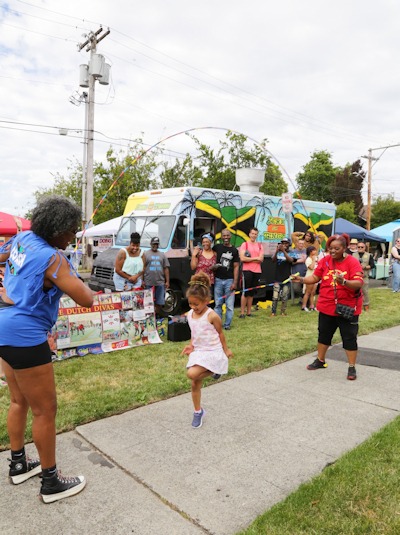
The park is already the home of the city’s Juneteenth celebration, and the development plan would center a space for Juneteenth and other large events while creating spaces for gatherings of different sizes and for meditation and reflection.
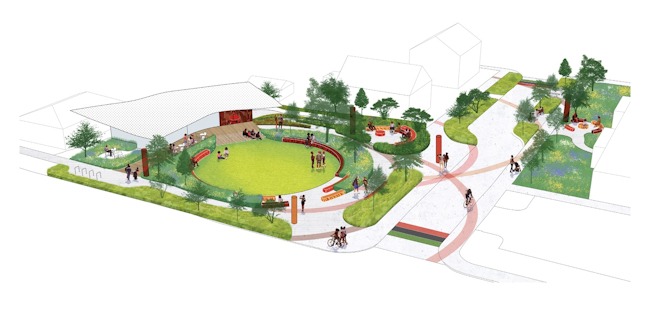
A preliminary drawing shows a series of circles defining the space, with curves linking the park to the festival street and the library. “Curves, circles and organic forms give a feeling of calm, embrace and protection,” according to the plan.
The proposal also includes a community center that would be part meeting space and part café. Its roof would offer shelter for both a stage and a porch.
The park would be a place imbued with stories of the Black community, expressed through two- and three-dimensional art, in words and through plantings. Art would be all around — on paved pathways, built-in seating, on wayfinding markers and in the plants in the garden.
The art would honor significant figures in Olympia’s history, with the plan suggesting pathways dedicated to community builders, sculptures with stories of creators and entrepreneurs, plants that represent land and food stewards, and seating including stories of trailblazing pioneers.
In its current form, the park includes a mural of Howard — who was both a pioneer and an entrepreneur — on a small building that would eventually be replaced by a new structure housing the café and community space.
From the 1850s to the 1870s, Howard ran, and owned with husband Alexander Howard, the Pacific Hotel in Olympia. She commanded — and when necessary, insisted upon — respect.
She would “challenge anyone, even legislators, who dared call her ‘Aunt Becky’ without her permission,” according to an account on the Olympia Arts and Heritage website (https://www.olyaha.org/howard-family-legacy). And in his book Rogues, Buffoons and Statesmen, Gordon Newell describes her breaking up a fight between two legislators by lifting one off the ground and holding him there until he settled down.
Illustration courtesy of the City of Olympia.