
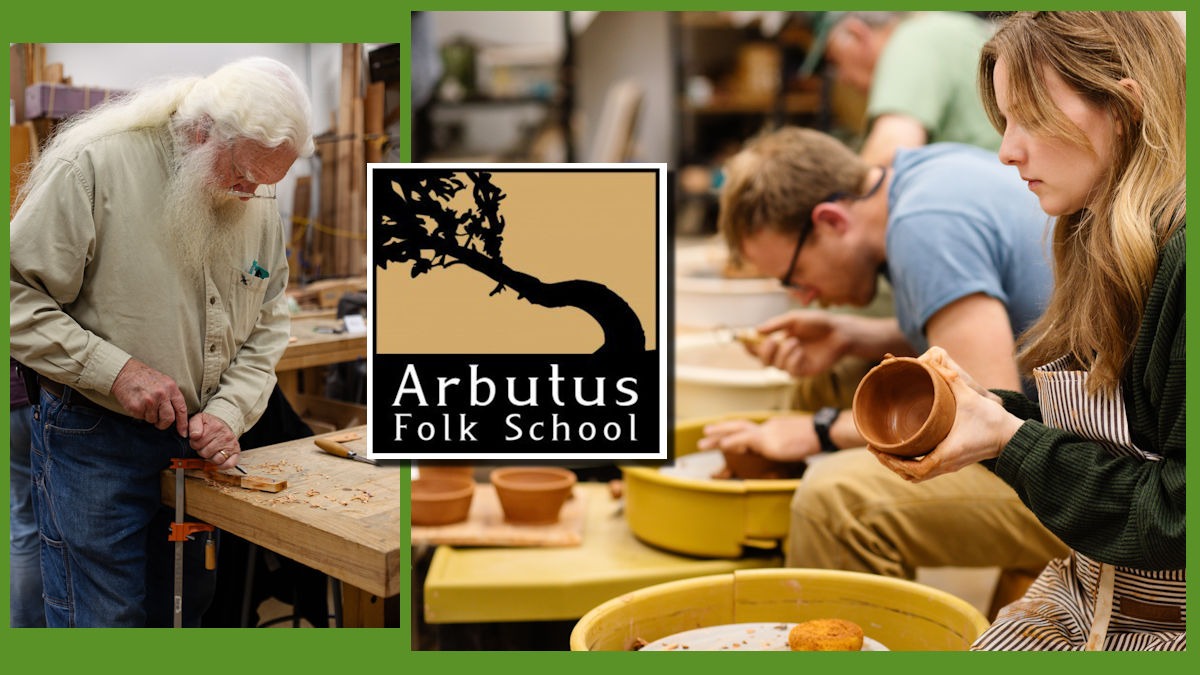
As with so many things, Covid almost shut down Arbutus Folk School in downtown Olympia. But North America’s largest urban folk school not only stayed open, but as the post-pandemic world sparked a demand for community-building activities, it grew larger and stronger.
“It came roaring back,” Executive Director Hillary Tully said recently.
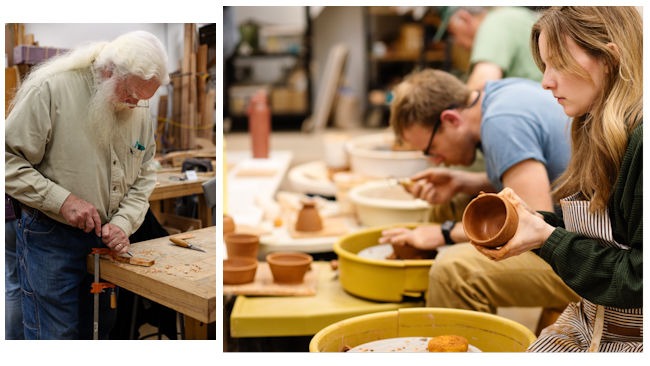
Right: A recent class in wheel throwing taught by Jane and David Stone.
Photographer: Devin Felix.
On any given day, and especially evenings and weekends, things are bustling at Arbutus Folk School. Walking in, you enter a large fiber arts room that also serves as a flex space able to host musical events, classes, or gatherings. Next is the woodshop, and. further in, you’ll find a ceramic studio complete with 11 potters’ wheels, plus shelves overflowing with newly-made vases and bowls. Upstairs there’s more space; a small meeting room, a kiln, an office and several studios.
Every day, classes are offered on topics ranging from woodworking to whittling, embroidery to lace-making, scrimshaw to stained glass. More than 100 classes will be offered in upcoming months, and in 2025, more than 1,000 unique individuals enrolled. At any given time, about 25 artists are teaching classes, and about 70 are employed throughout the year.
It’s not just the quantity but the quality of Arbutus Folk School that makes Tully proud.
“We have a great team,” she said. “Everything is such high quality.”
Soon, those instructors’ wares will be available to the public. The annual holiday Craft Market Fundraiser will take place Saturday, Nov. 21, from 10 a.m. to 2 p.m.
“It’s a nice time to see the space, and a fun time to come downtown to shop,” Tully said.
Folk schools began almost two centuries ago in Denmark, when the philosopher Nikolai Grundtvig captured attention with his concern that traditional schooling, with its emphasis on classical languages, created a rift between real life and learning, He encouraged instead the teaching of local crafts, including the making of products that people use every day. More then 50 folk schools sprang up in Denmark; in this country, folk schools became popular among progressives in the early 1900s. Many still exist, but mostly in rural communities; Arbutus was the first to take hold in an urban setting.
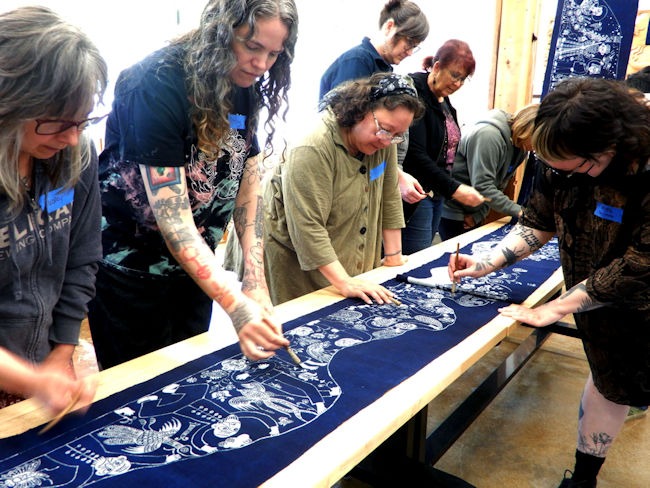
Photo by Kuen Kuen Spichiger.
Arbutus has been a presence in downtown Olympia since 2013, the brainchild of Stacey Waterman. A longtime climate policy analyst who worked for the state, Waterman was committed to her career, but after the economy crashed in 2008, the national effort to effect climate change also stalled. Seeing global attempts to make a difference through policy falter she decided to try a different approach.
“I started to think about what resilience looks like,” Waterman said in a recent interview. “I started to think about how to develop a local economy around traditional crafts.”
Those thoughts led her to the folk school model. After quitting her policy job and spending months researching how to start a nonprofit, she plunged ahead, and Arbutus was born. Things moved slowly at first, the school was faced with funding shortfalls and unwanted moves.
“It took a long time to build capacity,” Waterman said. “But we were scrappy. We kept at it.”
Waterman served as executive director through the growing process. In 2020 she stepped down, and Tully was hired. Waterman is grateful for the strengths her successor brought to Arbutus, which include fundraising and development. Under Tully, Arbutus has branched into more collaboration, partnering with such entities as the Timberland Library and Hands-on Children’s Museum. The school prioritizes serving underserved populations, Tully said, including offering some classes in Spanish.
While not officially on staff now, Waterman still visits. And though seeing people learning new skills is gratifying, she’s most excited about seeing the joy on faces.
“People love the classes,” she said. “They love being able to be in community this way.”
While Arbutus more than doubled its space with a move a few years ago, Waterman thinks more growth is possible. She’d love to see welding classes, for instance, and glass-blowing.
“We could be doing more,” she said.
Tully is also a visionary, and hopes to expand Arbutus into more classes for children. In the meantime, she wishes she could convince those who “think they aren’t creative,” to just jump in and give it a try.
“I often have people say to me, ‘I meant to take a class there,” Tully said. “And I’m thinking, ‘What’s stopping you?”
WHAT
Arbutus Folk School
WHERE
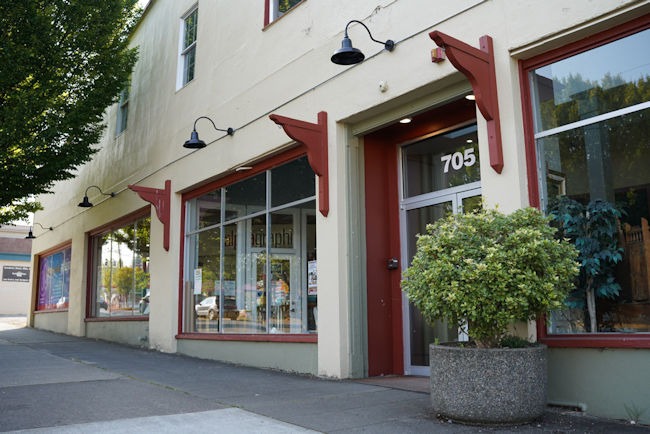
705 4th St. E Ste 101, Olympia
WHEN
The semi-annual Craft Market Fundraiser takes place Saturday, Nov. 21, 10 a.m. to 2 p.m.
Classes are ongoing.
COST
Fees vary per class.
FOR MORE INFORMATION
https://arbutusfolkschool.org/ — info@arbutusfolkschool.org
and
Arbutus Folk School – Love Downtown, Love Oly
A two minute video on YouTube by Olympia Downtown Alliance
https://youtu.be/lCl50lFiK7w?si=li2pS0EcxxxoOi4k