

The Phantom of the Diner, On Edible Art — Part 3: Croissants
by The Phantom
Consider, dear reader, the croissant, that golden crescent of flaky delight. What, the Phantom asks, is it? Not much, one might say. Some flour with yeast, a little sugar, a pinch of salt. Add water and mix. Fold in a generous block of butter and one has all that is necessary to make a platter of lovely, airy, croissants.
Anyone can do it, no?
Perhaps not. One could as well assert that Debussy’s Clair de Lune from Suite bergamasque seems a not particularly challenging piece for a moderately skilled pianist to perform.
One would be quite wrong. To play the work with the passion it calls out for, to bring such evocative sensitivity to its elongated fermata notes, floating weightless in the air as they do, known to cause the hardest of men to weep, requires a level of artistic ability possessed by few pianists. The art is in the technique.
Likewise, the creation of a beautiful croissant is no simple matter. The proper ingredients must be assembled: the perfect flour for the ambient climate, the correct yeast correctly handled, a quantity of rich European butter. The water must be pure and balanced.
The process of lamination that follows: the rolling and folding again and again to create the many layers that bring such lightness to the pastry calls for great skill. (How many layers? The Phantom loses count.) Throughout, temperature control is vital. Timing and patience are of the essence.
In the end, a single croissant is a product of a three-day creative process. And yet we have, here in Olympia, artists who attain such a level, and do so repeatedly, consistently, for the public good.
Thoughts of the croissant bring to mind a sojourn in France several years ago. In the good company of a most delightful companion, the Phantom travelled widely in that land so rich in the culinary arts. An extended stay in Paris, ensconced in a suite in the Saint-Germain-des-Prés district, was followed by a leisurely tour via motorcar of the richly historic Breton peninsula.
The Phantom must report that, while the entirety of the pilgrimage was most enjoyable, rather extended periods of time in both Paris and Brittany passed between meals. These intervals were largely occupied with visits to seemingly innumerable cultural sites: the museums — the Musée d’Orsay, the Cluny, the Centre Pompidou — the many churches — the Cathédrale Notre-Dame de Paris, of course, the stunning Église Saint-Sulpice, the famous Mont Saint-Michel, looming over the English Channel in the mist, the quaint and simple country chapels that are a sine qua non of every Breton village. The Phantom had not known the French to be so devout.
There was as well a great deal of walking: walks to Picasso’s studio in the Latin Quarter and up to Montparnasse, strolls in the Jardin du Luxembourg, explorations of the acres and acres of the mysterious Neolithic megaliths and cairns at Carnac and Locmariaquer.
But, friend, while these excursions were truly edifying, the Phantom need not tell you that what was most anticipated — the moments most treasured — were, of course, the meals. Oh, the meals! The meals were glorious!
France is well understood as the motherland of the culinary arts. She is, after all, the birthplace of the great gourmands, Jean Anthelme Brillat-Savarin and Georges Auguste Escoffier, the home of Le Cordon Bleu, the land to which Julia Child sojourned for many years before producing her towering work, Mastering the Art of French Cooking, and so changed life on Earth as we know it. And it was on a tidal flat on the Bordeaux coast where a boy in a fisherman’s skiff at sunrise discovered the simple joy of oysters pulled from the mud, shucked, and swallowed. “I blame my first oyster,” said a grown Anthony Bourdain, “for everything I did after.”
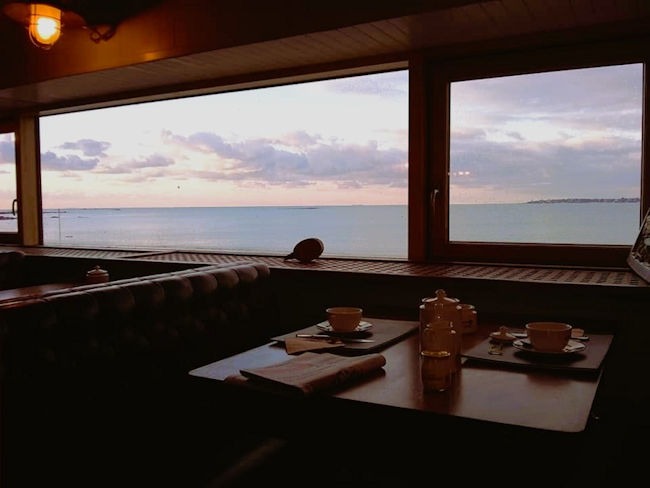
So, yes, gentle reader, the meals were exquisite. Lunch was often something simple: a baguette with butter and brie, a bowl of soup, a crêpe. Dinners were more complex affairs: coquilles Saint-Jacques followed by a delicate sole à la meunière on the seaside at Concarneau, escargots à la bourguignonne to start, then confit de canard at the Brasserie Lipp in Paris. Always fromage, and more wine. The memories are treasures.
But we digress. Or do we? Let us return to the matter of the croissant.
In both Paris and Brittany it became the Phantom’s practice to arise with first light and venture out to tour the local food markets. Such wondrous places these are: large, indoor halles in the cities, with dozens of vendors, and small, outdoor, marchés in the villages. The bounty was overwhelming: breads, meats, cheeses, vegetables, all manner of fresh seafood, pâtés, mushrooms, oils, flowers — all fresh, all beautiful. The Phantom has never experienced such joy!
These explorations would start with a quiet moment over a cup of rich coffee and a warm butter croissant — perhaps some fresh fruit as well, or a small piece of quiche. (Never shop on an empty stomach!) Such moments were blissful meditations. These simple pleasures, friend, are the experiences to which the Phantom refers with the admonition: “enjoy every bite.”
Thus fortified, spiritually and gastronomically, we were prepared to venture into the day.
What has all this to do with art in Olympia, you ask? The question is pertinent.
The Phantom is pleased to advise you, fellow Olympians, that within our lovely little commune we have not one, but two establishments in the French tradition that create for us the most beautiful croissants possible, works of art of the highest quality and culinary achievement. We are most fortunate.
The more senior of the two is the Bread Peddler, a boulangerie located in the 222 Market in downtown Olympia. Its founder and creative force is one André La Rest. As it happens, Monsieur La Rest came to us from — where else? — a village in southwest Brittany, where he was steeped in the ancient arts of breadmaking.
To visit the Bread Peddler is to find oneself in a Breton kitchen, well-trod wood floors underfoot and the air warmed by the aromatic richness of bread in the oven. And such breads! Excellent, hearty baguettes, of course, but also a selection of traditional loaves found nowhere else in the vicinity.
For those looking for a meal, simple breakfasts are available — excellent quiches, egg sandwiches, yogurt with fruits –— and lunches —beautiful soups and a selection of sandwiches.
But central to discussion today, of course, is the croissant. The Phantom can tell you that Bread Peddler croissants are gorgeous. So lovely are they that one is reluctant to tear the creation asunder and consume it — but torn and consumed they are.
Beyond the pure butter croissant, the Bread Peddler creates daily a variety of sweet and savory croissants. The almond is a favorite, as is, of course, the pain au chocolat. A croissant filled with ham and cheese constitutes an excellent lunch.
The Bread Peddler will also tempt innocents with that decadent cousin to the croissant, the kouign-amann, the notorious little cake that has been deemed “France’s most extraordinary pastry.” What, one might ask, is a kouign-amann? Well, imagine, if you will, dear reader, beginning with a buttery, crisp, flaky croissantaugmented with yet more butter, and much more sugar, and a pinch of salt thrown in. This new creation is then squeezed into a muffin tin and baked. The result is a buttery, textured and very salted-caramel sort of croissant. Try one.
But, friends, there is more! A mile to the east stands a younger establishment with a stellar reputation that belies its tender years. The Left Bank Patisserie, born of humble beginnings on 4th Avenue near downtown Olympia, and has been moving up ever since, both literally and figuratively.
Two relocations to meet growing demand have brought The Left Bank to its current location atop the crest of the east side hill, just beyond Ralph’s Thriftway. A listing by Food and Wine magazine as one of America’s finest bakeries has brought this Patisserie to a height of confectionary recognition. Founder andpâtissier of the Left Bank is one Gary Potter, an American who learned his art at Le Cordon Bleu and returned to his native Washington to delight us.
If the Bread Peddler is a country kitchen, the Left Bank evinces a thoroughly cosmopolitan aesthetic. Its public area is spacious and modern, spare bordering on minimalist. Very Parisian. Interior windows offer a peek into the orderly kitchens where the magic happens. An hour in the Left Bank is a calming respite between a visit to the cemetery at Montmartre and preparations for an evening at the Opéra national de Paris. It is to wander about on the crooked streets of the 6th arrondissement.
What is not minimized are the offerings: luscious tarts, colorful macarons, perfectly executed cannelés de Bordeaux and mouth-watering, rum-soaked bostocks. There are cakes, cookies, savory quiches. Fresh berry pastries and holiday desserts are baked according to the seasons. No breads, no sandwiches: this is a pâtisserie, not a sandwich shop.
But we begin and end, as always, with the croissant. The plain butter croissants are, of course, consistently impeccable: deeply browned, delicately crisp on the exterior, airy and honeycombed within. The Left Bank also bakes a similar selection to those of the Bread Peddler: the almond croissant, the pain au chocolat, croissants with fruit, with cheese, with ham, with turkey and pesto.
Where, you may ask, should one go for the complete croissant experience? That is a choice with which the Phantom cannot be of assistance. From which is the greater joy to be found, a morning in the country, or an afternoon in the city? There is no error possible. Enjoy one on one occasion and the other on another day.
Until next time, my friend, enjoy every bite. Every day is a holiday.
–#–
Did you miss other parts of The Phantom’s Oly Arts column? Read them here.