
Life and the afterlife are mined for meaning in this new and local play.
Though thoughts of the afterlife continue to occupy our minds, the ways in which artists depict the great beyond have evolved over time. We don’t get as much of the surreal nightmare fodder of a Hieronymus Bosch, and instead tend to get representations of the afterlife as a kind of bureaucratic processing center. It’s perhaps a bit revealing that movies, books, and plays so frequently choose to understand the afterlife through middle managers, receptionists, long lines, and red tape.
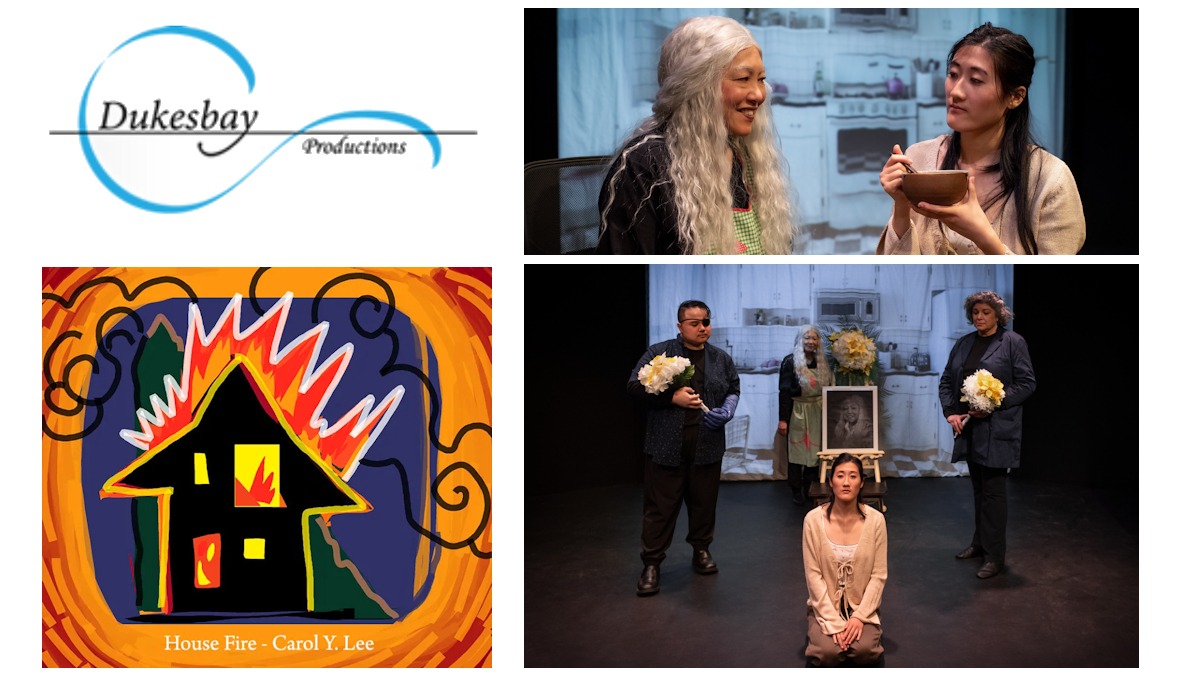
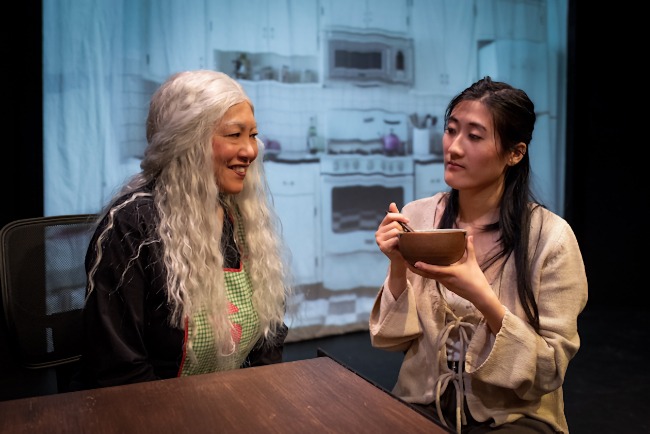
In House Fire, what we’re seeing isn’t technically the afterlife, but rather a kind of purgatorial weigh station where Laurie (Jane W. Davie) finds herself after dying at the too-young age of 29. We quickly learn that Laurie was in a bit of a holding pattern in life, as well — a college dropout, working a job she doesn’t care about, in a relationship that’s gotten too serious too fast, drinking a bit more than she ought to, and aimlessly drifting along. When the titular house fire ends it all, she says she was this close to changing her life for the better.
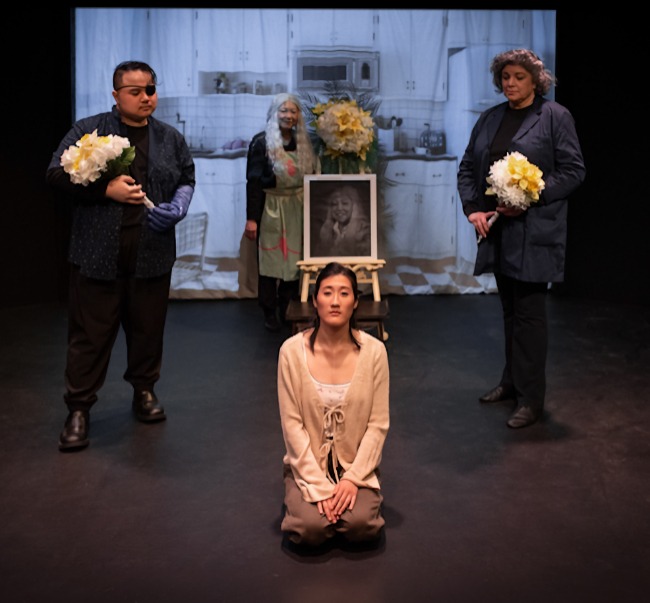
And so, in this purgatory, Laurie is assigned three deceased people, all of whom she knew when they were alive, to take care of her “orientation” before she can move on to whatever the afterlife has to offer. First, there is her Grandma (Joy Misako St. Germain), who was distant in life, but affectionate in death; her fiancé Paul’s mother Doc (Maria Valenzuela), whose tough exterior hides a well of sadness; and Wallace (Jonna Nguyen), who Laurie vaguely remembers from school, but who is otherwise a stranger.
Through a series of one-on-one chats with her spiritual guides, Laurie learns as much about the secret lives they led as she does about her own lost and searching existence. The tone is largely melancholy, with little bits of humor that don’t always connect. (Wallace has a robotic arm that mostly serves as a sight gag that starts out more distracting than funny; but, its eventual explanation, and Nguyen’s evolving physicality with it, bring it around to being touching.)
This is a production from Dukesbay, which tends to focus on new and local plays, of which House Fire is both. Seattle-based playwright Carol Y. Lee authored the play, which seems to come from a deeply personal place, stuffed as it is with scattered thoughts and a lifetime of preoccupations to explore: alcoholism, life as a second-generation immigrant, rebelling against a religious upbringing, rebelling against militant atheism, selfishness in relationships, undiagnosed neurodivergence, and more.
In all of this philosophizing and self-reflection, it can sometimes be a bit hard to access the humanity. Valenzuela and Nguyen feel the most natural and emotionally resonant, but they may also just be blessed with more intriguing characters — with Doc being fiercely protective of her inner life, and Wallace being youthful and lonely, they’re able to interact with Laurie in more interesting ways.
For as shaggy as House Fire can sometimes feel, there is a lot to admire about what it chooses to explore about regrets, wasted potential, our place in the vastness of the universe, and whether any of that matters at all.
WHAT:
House Fire
WHEN:
7:30 p.m. Friday-Saturday and 2 p.m. Sunday through March 29
WHERE:
Dukesbay Theater, 508 S. Sixth Ave #10, Tacoma, WA
COST:
$20
LEARN MORE:
https://dukesbay.org/shows/
(253) 350-7680