

Stories of Immigrant Life Through the Stories of the Marketplace
“A marketplace is more than a site of trade; it is a cultural space where people gather, exchange, and sustain community.”
Curator Kellis Partlett says the idea for the show came from hearing Jo Young-nam’s son Hwagae Market on the radio. She says it’s well known among the older generations especially. She says the lyrics describe the lively colorful character of the market perfectly, which got her thinking about Pike Place Market in Seattle.
Korea’s Hwagae Market, is situated in Korea outside Seoul, on the border of the provinces of Gyeongsang-do and Jeolla-do which makes it a natural gathering place between east and west Korea. Pike Place Market is also its own cultural exchange where the diaspora of Seattle meets and shares food, mementos, rituals, arts and crafts.

Photo by Lynette Charters Serembe.
All markets are a cultural exchange which is what makes markets an important part of many of our lifestyles. What we choose to eat, and how we prepare and present it, what we choose to wear, or make, is the fun part of the exchange and people revel in the sharing of all of this, and all the arts disciplines.
The art shared in the show is from fourteen artists selected from the Korean American Artists Association of WA which makes for a very mixed response to the theme aesthetically, with styles ranging from surreal painterly studies, still life and folk art in style, to collage, wire work, and installations.
The show description reads “Markets are symbols of exchange” within the show are specific and personal, as well as universal depictions of these exchanges. Many express nostalgias, showing how very far from Korea they have travelled, and how many riches they have contributed to our local communities.
Patsy SURH O’Connell has two pieces in the show depicting her famous peonies which in Korea symbolize wealth and honor. There is an 8-foottall tall’ wallpaper hanging with ink and stitched collage depicting black birds with peonies and various samples of Korean fabrics. The other is “On the Way to the Market.” The delicate brilliance of the peonies against the unyielding stone wall are seemingly engaged in an unlikely but unified dance.
Kristin Choi has two almost fluorescent brightly colored oil paintings. A picture on a circular canvas of someone in a white hanbok (traditional Korean dress) falling down a “Did You Follow the White Rabbit?” hole. possibly symbolizing an unexpected journey, such is the immigrant’s journey, the color white denoting purity and innocence. “The Mugunghwa” shows cheerful pink/purple hibiscus flowers, South Korea’s national flower, associated with immortality and eternal love, with rich green foliage against high clouds on a sunny day, all overpainted on a bright orange undercoat.

Photo by Lynette Charters Serembe.
Monica Bae also depicts the beloved national flower in a swirling arrangement, next to a solitary but statuesque moon jar (a traditional Korean white porcelain jar originating from the 1300s) in her oil painting “The Scents of my Homeland.”
Kyong Oh’s paintings of moon jars floating in space placing cultural significance on the universal ritual of gazing at the moon to connect with loved ones afar. In contrast, her “SkyRoad” is a creative and surreal mixed media painting showing space traffic of a different kind, the debris of commercialism between the nations.
Hyosoon Jung’s paintings juxtapose surrealism and pointillism on a textured background in a folk-art style complete with familiar commercial symbols from a famous Seattle coffee shop and football team.
Onsik Shim also embraces elements of pointillism in the flowers surrounding their colorful depiction of people gathering at market.
Emily Joughee Won shows relief ‘wire drawings” skillfully doodled from copper wire depicting playful images of various people meeting and greeting one another.
Myoung Suk Sweet’s endearing depiction of “At the Market” with people from all walks of life in a common meeting place.
There is a selection of paintings by Mira Kim. These are lyrical, layered, and painterly with dreamlike surreal depictions; they are exchanges of music and memories.

Photo by Lynette Charters Serembe.
Jennifer Kwon shows an oil painting of a turbulent seascape. An expression of distance, and rough crossing perhaps?
Myong Ae Lee’s contemplative watercolor “Summer House” imagines us taking a break from it all.
Jungho Kim’s “Right Here, Like This” uses traditional Korean style fabric as a canvas, like a fractured QR code made of small square mirrors suggests the disorientation and the fragility one feels in the potential loss of identity experienced in having been relocated. “Right Here, Like This 2” is a beanstalk of serifed letters. Unscrambled, you can make out the word KOREAN, in English. They are collaged with Korean lettering, and in the middle of the ‘O’, there is a metallic silver ‘&.’
Sun Hui Watkins’ “Old Pines in the Mist” is a glorious acrylic triptych in traditional Korean ink art style rendering the old trees, with limbs missing, their foliage is aged and diminished, the trees are bent over from being wind-weathered, but their trunks are still strong.
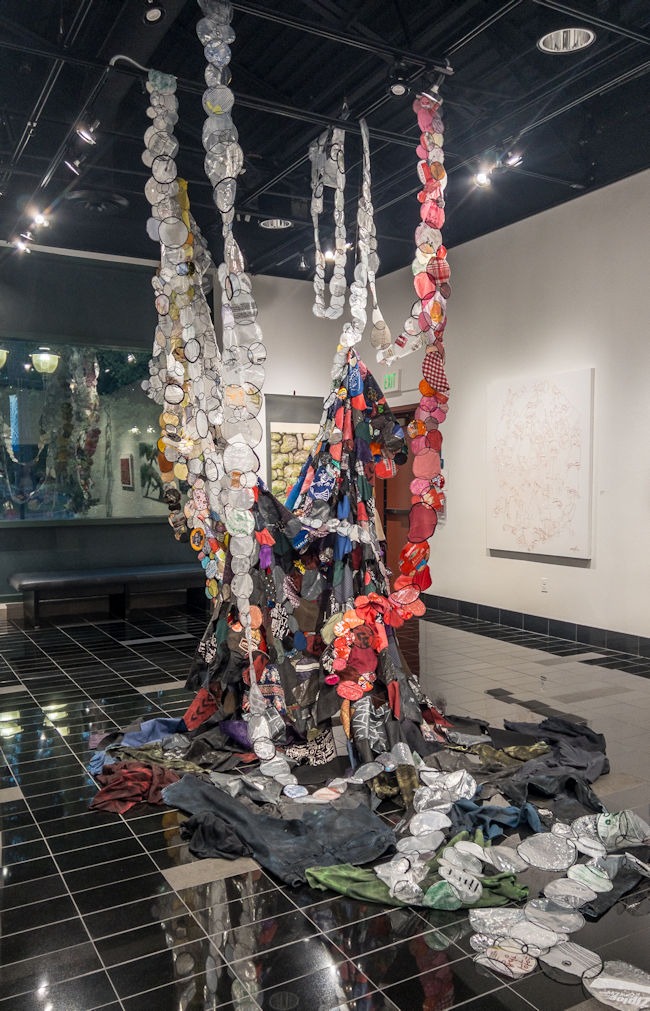
Last but not least is Bella Kim’s “Arirang 2.0” (Arirang is a Korean folk song which is believed to be more than 600 years old). Kim’s installation is like a large, deflated peacock trail of cascading circles of recycled fabric sewn together, which starts white at the ceiling and becomes more colorful in the center; as it hits the floor the colors turn darker toward the end, while transitioning into larger pieces evolving or devolving into whole identifiable items of clothing. The piece is an enormous 27 inches long.
Combining the spirit of these two markets is a clever way of not only acknowledging how far the artists and their families have travelled, but also what customs, gifts and treasures they bring to enrich and educate our lives. Gifts whereby we learn that we are the same the whole world round, while being so intriguingly different.
“Our community, having crossed the ocean while holding onto its roots, has built new lives and new bonds in the United States, echoing the enduring spirit of the marketplace.”
“Through these diverse forms, we hope to foster deeper empathy and understanding of the immigrant experience, especially among those who live in Washington State today.”
WHAT:
Fine art show: From Hwagae Market to Pike Place Market
WHEN:
Through October 16, Mon-Fri, noon to 6 p.m. excluding holidays
WHERE:
Leonor R. Fuller Gallery at South Puget Sound Community College, Kenneth J. Minneart Center for the Arts, 2011 Mottman Rd SW, Olympia
HOW MUCH:
Free