
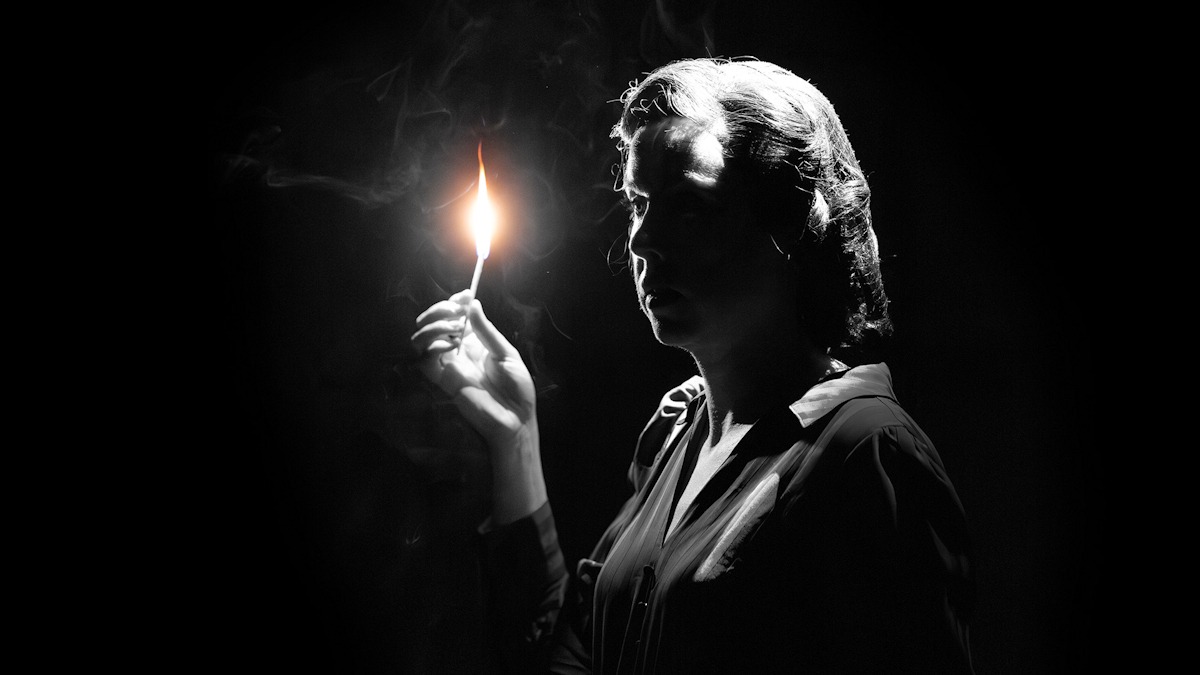
Harlequin’s 2026 Season Begins with a Classic Thriller—Given a Film Noir-style Makeover
The playwright Arthur Knott wrote few plays, but of his three thrillers, two are considered classics. Dial M for Murder, his first and best, is constantly revived in professional and amateur productions. After a sophomore slump (Make Me A Murder) came his third and final thriller, Wait Until Dark. The play was a hit and has had many revivals, but it’s more problematic — while the premise of a blind woman trying to fend off a gang of criminals is electric, the plot meanders and there are a few too many red herrings and unresolved plot points. “Kott was a great playwright, at least with Dial M, but this one needed some work,” says Aaron Lamb, Harlequin’s artistic director who’s helming a new production of Dark, opening January 23rd. “And I think Jeffrey Hatcher’s adaptation is very interesting. Above all, he really moves this script, and he tightens the plot some too.”
The play premiered in 1966 with a film version following the next year that featured Audrey Hepburn as Susan Hendrix, a newly blind young woman drawn into a deadly conspiracy of drug runners and a hidden fortune in heroin. In addition to tightening the script, Hatcher’s adaptation moves it back 20 years to 1944, providing a different backstory for the characters and more logical consistencies to the plot.
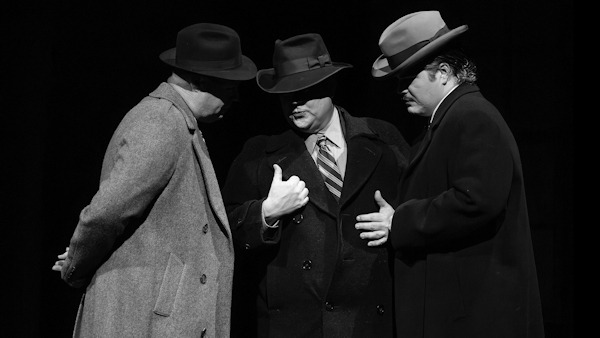
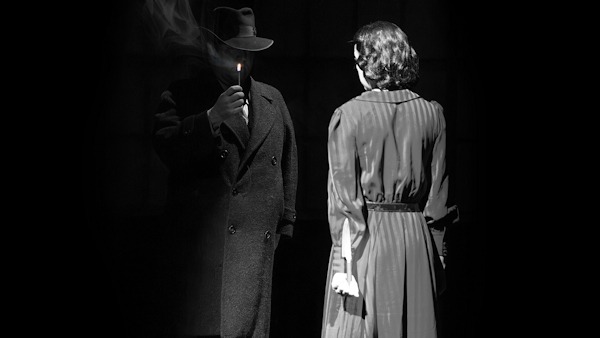
To heighten the film noir fun, the production is presented in glorious monochrome, with black and white sets and costumes, and make-up and light trickery to mimic the look of a classic black-and-white thriller.
Lamb admits that unlike much of the work at Harlequin this play isn’t one that’s necessarily doing much heavy lifting regarding more serious themes, though since it centers around a blind woman, it “allows us a conversation about ability and assumptions about how we think of people who are sight-impaired.”
“It’s her experience, we see it through her ‘eyes.’ It seems like she’s completely at the mercy of all of these deceptions and manipulations. But everybody else in the play underestimates her abilities, including her.”
To assist both actress Helen Harvester (who plays Susan) and the production team, the company brought in a sight-impaired consultant, Chandra Scheschy, a theater professional recommended by the Washington State Department for the Blind. “It’s easy for us to make assumptions and to put them onstage,” says Lamb, “and already a lot of the assumptions we would have made have been answered differently than we thought.”
Harvester’s a Harlequin regular, and Lamb’s partner — though it’s neither the first time they’ve worked together or that he’s directed her. When asked the best and worst things about their working relationship, he laughs. “The best thing is we speak each other’s language…and the worst thing is we speak each other’s language.” He mentions it’s been a while since they’ve worked together at the theatre. “Sometimes it feels like it could be awkward, but honestly, we’re both asked all the time by regulars when we’re going to be back on stage.”
While the 2026 Harlequin Season is starting out with an acknowledged entertainment, what stretches ahead is an intriguing mix of contemporary dramas (Lynn Notage’s Sweat, The Children by Lucy Kirkwood, Martyna Majok’s Sanctuary City), American classics and comedies (Our Town, The Foreigner, Barefoot in the Park) and yes, Million Dollar Quartet, because sooner or later there’s always a regional theatre-sized musical in a season. (There’s also a new play by Tlingit playwright Frank Henry Kaash Katasse, When the Summit Meets the Stars, on my personal pick list.) When he considers the months to come, Lamb says the thing he’s most excited about overall is what he feels is a re-dedication to the form of live theatre. “I’ve been working on my mission statement,” he laughs, before beginning.
“Here it is: live theatre is about asserting our own humanity. There’s less abstraction in theatre between artist and audience than there is in ballet, in opera, in other forms, where the art comes from music or somewhere else. You see someone on a stage, you see yourself, or someone who is acting very much like you might in such circumstances. When we’re doing our job, we’re not just giving you a great time, but we’re understanding ourselves more and our audiences more. It’s a democratic artform in that sense.”
Photos by Shanna Paxton Photography.
WHAT:
Wait Until Dark
WHEN:
7:30 p.m. Thursday-Saturday, 2 p.m. Sunday, Jan. 23-Feb. 8
Special Performances:
Community Talkback – Jan 25 2PM
Closed Captioned – Feb 1 2PM
Audio-Described – February 6 7:30PM
COST:
$35-$49
LEARN MORE:
https://harlequinproductions.org/show/wait-until-dark/