

Can you save your son from flowing away?
The titular “pipeline” of Pipeline refers to the systemic funneling of young people of color from schools to prisons in America. Despite the weightiness of this concept, Lakewood Playhouse’s production of Pipeline isn’t as daunting or sprawling as other recent, socially-minded productions like The Normal Heart or For Colored Girls…. Pipeline’s power comes from narrowing its focus to one snapshot of a moment in time for some teachers, students, a security guard, and two parents, where the future of one kid is put in jeopardy.
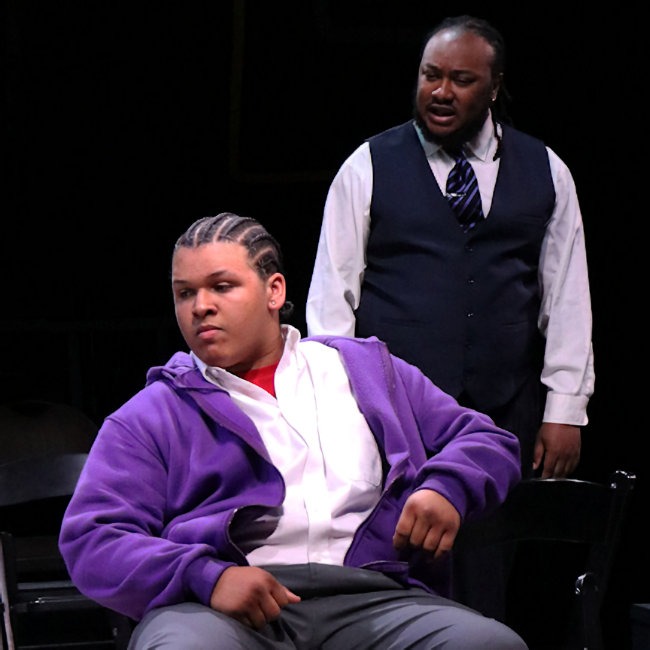
Pipeline — directed by Michelle N. Matlock and written by Dominique Morisseau — revolves around Omari, a high school student played by Isaiah Myers, who himself is a junior in high school. Omari shoved a teacher, which is his third offense, and is now in a situation where he can either run away or face the potential consequence of jail time. As a young actor playing his own age, wrestling with the fury and shame of his circumstances, Myers is a magnetic presence onstage. He’s able to play a character who’s smarter than he’s willing to let on, but too stubborn to back down from an impossible position.

Omari goes to a boarding school, but his mother, Nya (Whitney Crawford), teaches at the rowdier public school. Her confidante, Laurie (Diane Trotter), has been a teacher long enough to fondly remember spanking students, and is at a loss for how to deal with the troubles she sees on a daily basis. Dun (Don Anderson II) is the kindhearted security guard who’s sweet on Nya; Jasmine (Kaelynn Miller) is Omari’s concerned-yet-practical girlfriend; and Xavier (Darryin B. Cunningham) is Nya’s ex and Omari’s absent father.
What’s missing from this picture are expected tropes like a stern headmaster, an overzealous DA, or even the presence of the teacher who was assaulted. Instead, we have a group of people who are all too aware of the patterns that determine their futures, and who are existing in the moments right before a life-changing judgment will be given to Omari.
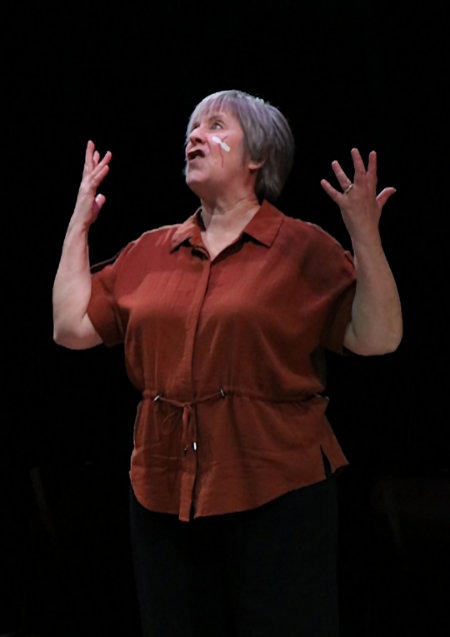
All along the way, Nya is haunted by We Real Cool, a 1960 poem by Gwendolyn Brooks that was written about the doomed machismo she saw from the neighborhood boys gathered at the pool hall. Nya worries that her child may have found himself in the counterintuitive pipeline of defending who you are, which leads to defying authority, which leads to prison.
Pipeline is defined by a spirit of helplessness from all characters involved. The mechanisms they would need to fight to change their circumstances are so vast and overwhelming that it’s fruitless to even consider fighting. When Laurie gets stuck in a situation where intervening was more harmful to her career than just walking away, she blames her fellow worker. There is no one else to turn to. And when Omari expresses why he attacked his teacher, we’re met with entirely understandable emotions, which had no reasonable release valve.
In Pipeline, we’re presented with less of a conduit, and more of a powder keg. In the face of this imposing machine, all we can depend on is the ability of humans to band together. Pipeline keeps that human connection intact.
WHAT:
Pipeline
WHEN:
7:30 p.m. Friday-Saturday and 2 p.m. Sunday through May 10
WHERE:
Lakewood Playhouse, 5729 Lakewood Towne Center Blvd., Lakewood
COST:
$25-$31, “Pay What You Can” May 3
MORE INFORMATION:
https://www.lakewoodplayhouse.org/pipeline.html